Using AI to help people working with children identify safeguarding concerns.
The Hartree Centre North East Hub worked with GoSafeguard to explore AI solutions to help people working with children identify safeguarding concerns more accurately and make more informed decisions.
Challenge
GoSafeguard was looking for a way to identify the most appropriate safeguarding category from written safeguarding concerns entered by staff and volunteers working with children. They had already developed an early detection system but wanted to improve its accuracy and reliability.The available data consisted primarily of trigger phrases and their associated categories. However, real-world concerns rarely follow the same structure and important safeguarding concerns are often implied rather than stated explicitly. In addition, a single concern may contain multiple overlapping safeguarding issues. Off-the-shelf AI tools included safety controls and safeguarded-related inputs were sometimes being blocked or restricted. These challenges limited the effectiveness and GoSafeguard needed to explore a more accurate and reliable method for concern detection and classification.
Approach
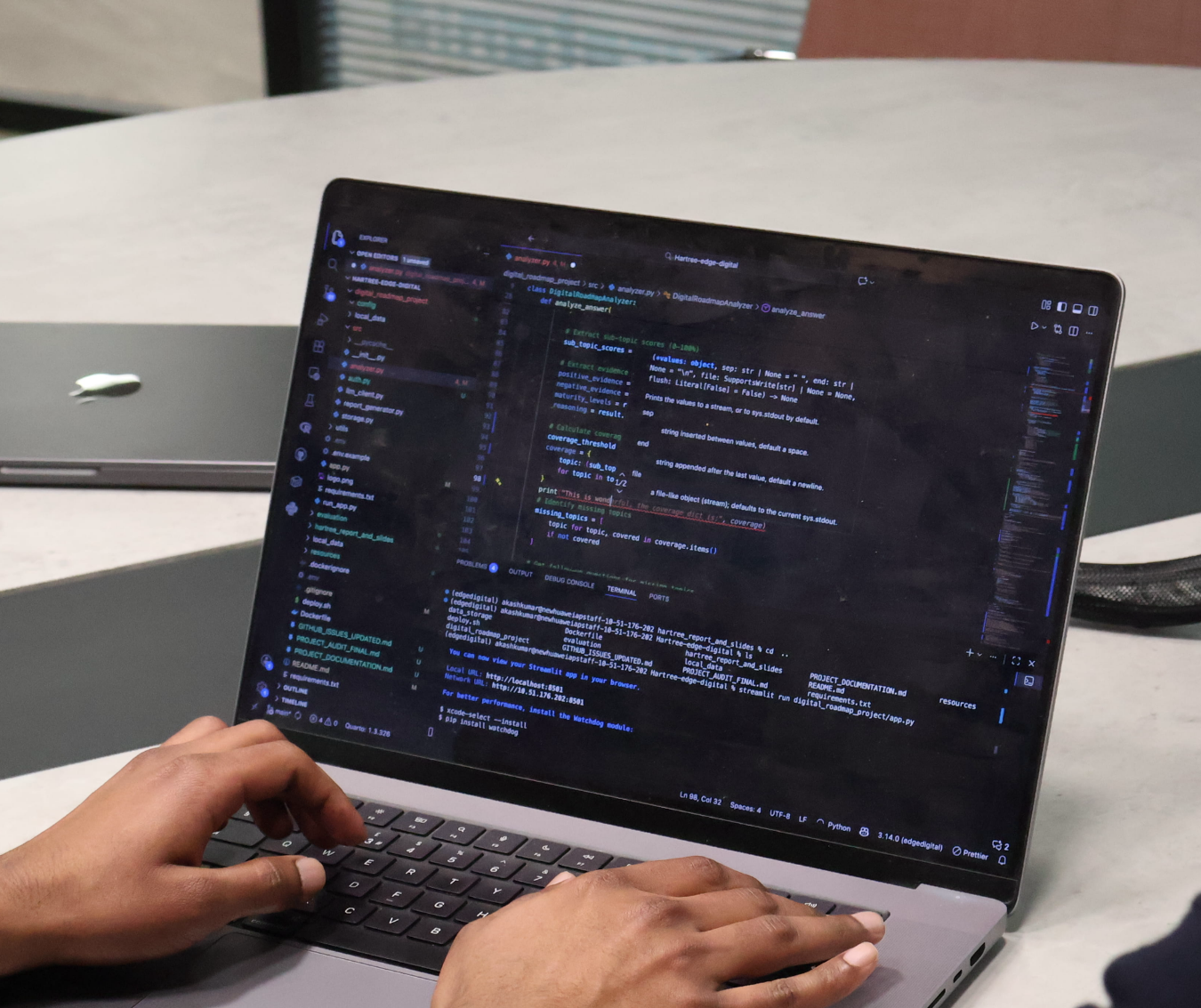
Data Scientists from the Hartree Centre North East Hub worked alongside GoSafeguard to explore how AI could improve safeguarding classification. The project began with dataset development, including expansion of the existing safeguarding trigger phrase library and generation of additional scenario-based examples to better reflect how safeguarding concerns are written in everyday language by people working or volunteering with children. This resulted in a richer training dataset covering a wider range of language patterns and safeguarding concerns. The team then evaluated multiple classification approaches, including rule-based matching, large language model (LLM) classification, embedding-based
retrieval methods, and fine-tuned transformer models. Following comparative evaluation, a multi-stage classification pipeline was developed that combines data preparation, classification, and human review into a reusable workflow. The resulting proof-of-concept demonstrated how machine learning models can move beyond simple keyword matching to identify safeguarding concerns from more realistic and nuanced written concerns.
Benefits
The project delivered an end-to-end safeguarding classification prototype capable of recommending appropriate safeguarding categories. The solution included a scenario-based demonstration using realistic safeguarding cases, a human-in-the-loop review workflow for validation and correction, and a reusable framework that can be continuously improved through the addition of new examples and retraining. For GoSafeguard, this was a significant step forward, helping to improve the accuracy and reliability of the existing detection system and creating a stronger foundation for future testing, pilot deployment and product development. Through the work with the Hartree Centre North East Hub, the model was also developed to identify safeguarding concern types from written concerns entered by staff and volunteers across a wider range of settings, rather than being limited to school-specific reporting language. This creates opportunities to apply the approach across other safeguarding-focused sectors, including charities, community organisations, sports clubs, faith groups and voluntary organisations.
"The support we have gained through the Hartree Centre North East Hub has been invaluable. Through earlier support from Sunderland Software City, we had been able to develop an initial prototype and proof of concept. This project then gave us access to the specialist data science expertise needed to build on that foundation and take the system to the next stage."
"The Hartree team helped us make important improvements to the accuracy and reliability of the model and move beyond school-specific safeguarding language. That is important because safeguarding does not just happen in schools. This work has given us a much stronger technical foundation to build a product that can identify types of safeguarding concern across a wider range of settings and support people who work or volunteer with children to make more informed decisions about next steps."
- Barry Reed, GoSafeguard
Further Information
This work was completed as part of one of our collaborative data projects. The projects are up to 12 weeks in duration and give you access to a wide range of expertise across our team of data scientists and data engineers. We will work alongside your team to scope your data science or engineering project, build a prototype solution, and explore options to deploy it within your organisation. You can learn more about them on our webpage here.
If you would like to learn more about the Hartree Centre North East Hub or our collaborative data projects, please get in touch with us at: hello@hartreenortheast.uk

.png)
%20(1).png)


